


Price: [price_with_discount]
(as of [price_update_date] – Details)

Bringing the Wild Indoors: A Comprehensive Look at The Peanutshell Tundra Explorer Crib Mobile
Designing a nursery is one of the most exciting milestones for expectant parents. It is the space where countless hours will be spent rocking, soothing, and watching a new life grow. Central to this sanctuary is the crib, and hovering above it, the mobile—a staple of nursery decor that serves a dual purpose: stimulating a baby’s developing senses and tying the room’s aesthetic together. The Peanutshell Crib Mobile for Boys or Girls, specifically the “Tundra Explorer” model with its distinctive woodgrain musical arm, enters this market promising a blend of whimsical design, versatile audio options, and user-friendly functionality. Based on the manufacturer’s specifications and product design, this piece positions itself as a strong contender for parents seeking a gender-neutral, feature-rich centerpiece for the modern nursery.
Aesthetic Appeal: The “Tundra Explorer” Theme
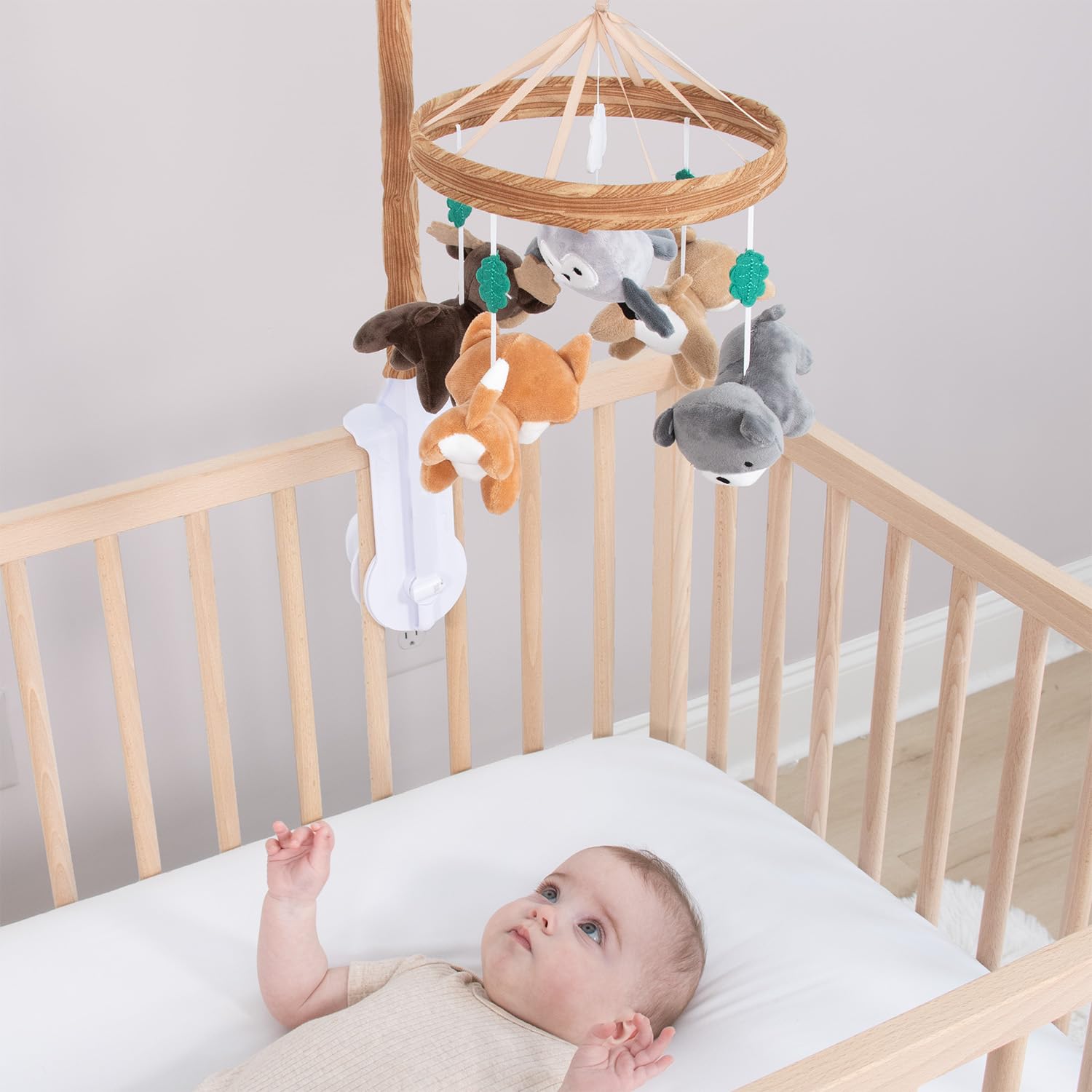
The visual identity of this mobile is immediately striking. Moving away from the primary colors or pastel pastels that dominate the baby market, The Peanutshell has opted for a “Whimsical Woodland” theme, branded here as the “Tundra Explorer.” The character lineup consists of five distinct plush animals: a bear, a deer, an owl, a moose, and a fox. These are not generic shapes; they are rendered with a modern, illustrated quality that feels fresh and stylish.
Surrounding this cast of characters is a base of green felt, grounding the airborne menagerie in a forest floor aesthetic. The color palette leans into nature—muted oranges, soft browns, creams, slate blues, and forest greens. This makes the mobile genuinely unisex, suitable for a baby boy, baby girl, or a gender-neutral nursery reveal. It avoids the trap of looking “babyish” in a way that clashes with sophisticated home decor. Instead, it reads as a deliberate design choice, capable of complementing modern farmhouse, Scandinavian, or rustic nursery themes.
The standout design element, however, is the arm and music box housing. Eschewing the standard white or brightly colored plastic arms found on budget mobiles, this model features a woodgrain finish. This detail elevates the entire unit. It mimics the look of natural timber, allowing the mobile hardware to blend seamlessly with wooden crib rails and nursery furniture. It signals a higher attention to detail, transforming the mobile from a mere toy into a piece of nursery furniture in its own right.
Auditory Experience: 12 Lullabies and Digital Clarity
A mobile’s rotation captures the eye, but its music captures the mood. The Peanutshell Tundra Explorer is equipped with a digital music box offering 12 distinct lullabies. This is a significant upgrade over the standard 2-to-4 song loops found on many competitors. With a dozen tracks, the auditory environment remains fresh for longer, reducing the likelihood of parental fatigue—that all-too-familiar phenomenon where a repeating melody becomes background noise at best, and an irritant at worst.
The library likely spans classic Brahms-style lullabies, gentle nature sounds, and perhaps softer instrumental versions of nursery rhymes, though the specific tracklist isn’t itemized in the specs. The key here is variety. Different babies respond to different tempos and timbres; one infant might settle to a slow waltz, while another prefers a steady, shushing white-noise-adjacent melody. Having 12 options allows parents to “A/B test” what works best for their specific child’s sleep cues.
Crucially, the unit includes volume control. This is a non-negotiable feature for any nursery sound device. The ability to dial the volume down to a near-whisper for a light sleeper, or up slightly to mask household noise (dishwasher, siblings, street traffic) during a nap, provides essential flexibility. The digital nature of the sound box also implies a cleaner, less “tinny” audio output compared to mechanical wind-up boxes, delivering a richer soundscape that is more pleasant for both baby and caregiver.
Functional Versatility: Three Modes, One Click
Modern parenting gear is judged by its ability to multitask, and the control scheme on this mobile is designed for maximum versatility with minimum friction. The music box features three distinct operational settings, managed via an easy one-click interface:
- Music Only: The arm stays stationary while the lullabies play. This is ideal for the older infant who has become overstimulated by visual movement but still needs an auditory sleep cue. It also saves battery life and reduces mechanical wear on the motor.
- Rotation Only: The plush ensemble spins silently. This serves as a purely visual tracking toy during awake windows—tummy time or quiet crib time—encouraging visual focus and depth perception without the auditory input.
- Music + Rotation: The full sensory experience. The classic mobile mode for winding down, signaling that it is time to sleep through both visual hypnotism and auditory conditioning.
The “one-click” mechanism suggests a rotary dial or a simple toggle button rather than a complex sequence of presses. In the bleary-eyed hours of a 3:00 AM wake-up, simplicity is a feature, not just a convenience. Parents can adjust the mode in the dark, by feel, without waking the baby further with bright phone screens or complicated button combinations.
Installation and Adaptability: Designed for Real Life
A beautiful mobile that takes an engineering degree to install—or one that only fits a specific brand of crib—is a frustration waiting to happen. The Peanutshell addresses this with a focus on quick set-up and universal fit.
The clamp mechanism is engineered to fit standard-size cribs. The description emphasizes a setup time of “minutes,” implying a tool-free, thumb-screw tightening system that grips the top rail securely. Stability is paramount here; a mobile that wobbles or slips down the rail is a safety hazard and an annoyance.
Perhaps the most thoughtful structural feature is the detachable arm. The music box and character assembly can be removed from the clamping base. This offers several practical advantages:
- Portability: The mobile unit can be moved to a pack-n-play for travel, a grandparent’s house, or a different room in the house without uninstalling the heavy clamp.
- Storage: When the baby outgrows the mobile (typically around 5 months when they start pushing up on hands and knees), the arm detaches for compact storage, leaving the low-profile clamp on the crib—or removing entirely.
- Cleaning: Plush toys inevitably collect dust or suffer spit-up incidents. A detachable arm makes it significantly easier to spot-clean the plush figures or wipe down the music box housing without maneuvering around crib slats.
Developmental Value: More Than Decoration
While the product description leans heavily on “charming nursery decor,” the developmental utility of a mobile like the Tundra Explorer is substantial.
- Visual Tracking: The gentle rotation of five distinct, high-contrast characters (the orange fox against green felt, the white owl against the woodgrain) encourages newborns to practice smooth pursuit eye movements. This is a foundational skill for later reading and hand-eye coordination.
- Color and Shape Recognition: As the baby ages (2–4 months), the varying shapes of the animals—antlers, ears, tails, wings—provide complex outlines for the developing brain to categorize.
- Auditory Discrimination: The 12 lullabies expose the infant to different rhythms, keys, and instrumentation, laying groundwork for language processing and musicality.
- Self-Soothing Association: Consistent use of the “Music + Rotation” mode at bedtime creates a powerful sleep onset association. The mobile becomes a cue: When the bear spins and the song plays, it is time to sleep.
Material Quality and Safety Considerations
The description highlights “plush” toys and “felt” surroundings. For a product intended for a crib, material safety is implicit. The Peanutshell is an established brand in the nursery space, generally adhering to ASTM and CPSC standards for children’s products. The plush construction means there are no hard plastic edges on the hanging elements—if a baby manages to grab a toy (once the mobile is lowered or during supervised play), the impact is soft. The felt base adds a tactile dimension; it is a texture distinct from the smooth plush, offering sensory variety.
The woodgrain arm is likely a durable composite or MDF with a laminate finish, chosen for weight-bearing stability and resistance to warping compared to solid wood, while maintaining the aesthetic. The clamp mechanism typically features rubberized or padded grips to protect the crib rail finish from scratches—a small detail that preserves the nursery furniture investment.
The “Charming Nursery Decor” Factor
The product description explicitly states: “More than just a musical nursery mobile, this piece doubles as the cutest nursery decor.” This is an accurate assessment. Because of the woodgrain arm and the sophisticated woodland palette, this mobile does not need to be hidden away when guests visit. It functions as a vertical design element, drawing the eye upward and balancing the horizontal line of the crib. In nurseries where wall space is limited (or renters cannot hang heavy art), a high-design mobile carries significant decorative weight. It anchors the “Tundra” theme, allowing parents to build out the room with matching crib sheets, wall decals, or rugs featuring bears, foxes, and trees.
Longevity and Transition
The lifespan of a crib mobile is inherently limited by safety guidelines: mobiles must be removed once the baby begins to push up on hands and knees (usually around 5 months) due to strangulation/entanglement risks. The Peanutshell seems to acknowledge this timeline through the detachable arm design. Once the mobile is retired from the crib, the plush animals themselves have a second life. They are well-made enough to become “loveys,” stroller toys, or decorative shelf sitters on the changing table. The music box unit, detached from the arm, could potentially serve as a standalone sound machine on a dresser (if it has a flat base or stand), extending the value proposition well beyond the mobile phase.
Potential Considerations for Buyers
While the feature set is robust, buyers should weigh a few factors based on the provided specifications:
- Power Source: The description does not explicitly state battery type (typically AA or C cells) or if an AC adapter is an option. Battery-operated units offer placement freedom but require ongoing cost and maintenance. Rechargeable battery packs are a popular modern hack for these devices.
- Rotation Speed: “Gently rotates” is the descriptor. Parents of high-needs babies sometimes prefer a slower, almost imperceptible drift, while others want a distinct movement. Without variable speed control, the factory-set RPM is what you get.
- Plush Detachment: It is worth verifying if the plush toys detach from the mobile frame easily for machine washing, or if they are sewn/permanently attached. “Plush” often implies surface wash only unless specified otherwise.
Final Verdict
The Peanutshell Tundra Explorer Woodgrain Musical Crib Mobile presents a compelling package. It successfully bridges the gap between a developmental tool and a design statement. The woodgrain arm is the hero feature, instantly modernizing the silhouette of the traditional mobile. The 12-song digital library with volume control respects the auditory environment of the home, and the three-mode operation (Music, Motion, Both) respects the changing needs of the baby from week to week.
It is a product designed with the parent in mind—easy to install, easy to move, easy to operate one-handed—while delivering the baby a rich sensory experience rooted in a cohesive, gender-neutral woodland narrative. For the parent curating a “Whimsical Woodland” nursery who wants a mobile that looks as intentional as the crib bedding and performs as reliably as a sound machine, the Tundra Explorer stands out as a premium, well-considered choice. It transforms the space above the crib from dead air into a focal point of calm, rotation, and melody—the very definition of a nursery essential done right.