



Price: [price_with_discount]
(as of [price_update_date] – Details)

Seeing the World Through Their Eyes: A Comprehensive Review of the TINITIGIES Montessori Mobile for Crib
The nursery is often curated with an adult’s aesthetic in mind—soft pastels, coordinated themes, and plush toys that look adorable on a shelf. However, developmental science tells a different story about what a newborn actually needs. For the first few months of life, an infant’s vision is blurry, limited to a range of roughly 8 to 12 inches, and incapable of distinguishing subtle color variations. What captures their attention, builds their optic nerve strength, and lays the foundation for cognitive focus is high-contrast imagery.
Enter the TINITIGIES Montessori Mobile Baby for Crib (Black and White Mobile – Animal Theme). This product positions itself not merely as a nursery decoration, but as a developmental tool engineered specifically for the “baby’s eye view.” Promising visual stimulation for infants aged 0–5 months, a digital music box with 12 lullabies, and a hardware-free installation, it aims to solve the common disconnect between what parents buy and what babies can actually see. This review dissects the design philosophy, functionality, safety specifications, and practical usability of the TINITIGIES mobile based on the manufacturer’s specifications.
Design Philosophy: The Montessori “Baby’s Eye View”
The central innovation claimed by TINITIGIES is a fundamental shift in perspective. Standard crib mobiles typically hang decorations vertically from a central arm. From the vantage point of a baby lying on their back, this results in a view of the bottoms of toys—feet, tails, and unfinished seams. The TINITIGIES mobile is explicitly designed to counteract this. The product description emphasizes: “No more boring bottoms! Your baby can now see the full patterns of crib toys hanging, keeping them engaged and visually stimulated.”
This aligns directly with Montessori principles for the visual mobile series (specifically the Munari and Octahedron mobiles), which dictate that mobiles should be presented at the correct distance and angle for the infant’s line of sight, offering distinct, high-contrast geometric shapes that move slowly with air currents. While the TINITIGIES unit is motorized rather than air-current driven, the design intent remains: the animal figures (whale, elephant, owl, etc.) are oriented to present their patterned faces and bodies fully to the baby below.
The aesthetic is strictly monochromatic. The description highlights five unique black-and-white patterns across the hanging elements. This is not a stylistic choice alone; it is a physiological necessity. The product marketing correctly notes that newborns “ignore the colorful crib mobile you bought” because their photoreceptors (cones) are immature. High-contrast black and white stimulates the rods in the retina, sending the strongest possible signals to the developing brain. By offering five distinct patterns—likely ranging from bold stripes and checkerboards to complex organic shapes—the mobile provides a “visual curriculum” that evolves with the baby’s increasing ability to track and discriminate detail.
Visual Stimulation & Developmental Window
The manufacturer targets the 0–5 month developmental window. This is the critical period for visual acuity development.
- 0–2 Months: The baby practices focusing. The high-contrast animals provide a stationary target that encourages fixation.
- 2–4 Months: Tracking begins. The motorized rotation (discussed below) encourages the eyes to follow a moving object smoothly across the midline—a crucial neurological milestone.
- 4–5 Months: Depth perception and color vision emerge. The mobile serves as a familiar anchor point during this transition.
The claim that this “enhances focus, attention span, and engagement” is consistent with pediatric ophthalmology guidelines regarding visual stimulation. By removing the “clutter” of low-contrast pastels, the TINITIGIES mobile reduces visual noise, allowing the infant’s developing visual cortex to process clear, distinct edges.
The Digital Music Box: Modern Mechanics Meet Classic Lullabies
Moving beyond the visual, the mobile integrates an upgraded digital music box, a significant departure from the wind-up mechanisms of yesteryear. Wind-up boxes are notorious for inconsistent speeds, grinding gears, and short playtimes (often under 3 minutes). The TINITIGIES unit specifies a digital system powered by 2 AA batteries (not included) with three distinct operational modes:
- Rotation Only: Visual stimulation without auditory input—ideal for alert playtime or babies who are overstimulated by sound.
- Music Only: Auditory soothing without movement—useful if the baby finds the moving objects distracting while trying to settle.
- Music + Rotation: The full sensory experience.
The playlist comprises 12 soothing lullabies, including standards like Twinkle Twinkle Little Star, Brahms’ Lullaby, and Rock-a-Bye Baby. Each track runs 1–2 minutes, cycling to provide variety. A critical design detail is the default volume setting. The unit ships preset to the lowest volume level. This is a thoughtful safety feature; a sudden loud mechanical noise can trigger the Moro (startle) reflex in a sleeping newborn. Volume adjustment is handled via simple (+) and (-) buttons, allowing parents to find the precise decibel level suitable for their room’s acoustics.
The 30-minute auto shut-off timer is a standard but essential feature for sleep hygiene. It prevents the mobile from running indefinitely, saving battery life and ensuring the nursery returns to silence and darkness, signaling deep sleep cycles. The manufacturer notes a “rotation-only mode” which, if accidentally selected, would explain a silent mobile—a troubleshooting point addressed in their FAQ.
Installation, Compatibility, and Safety Engineering
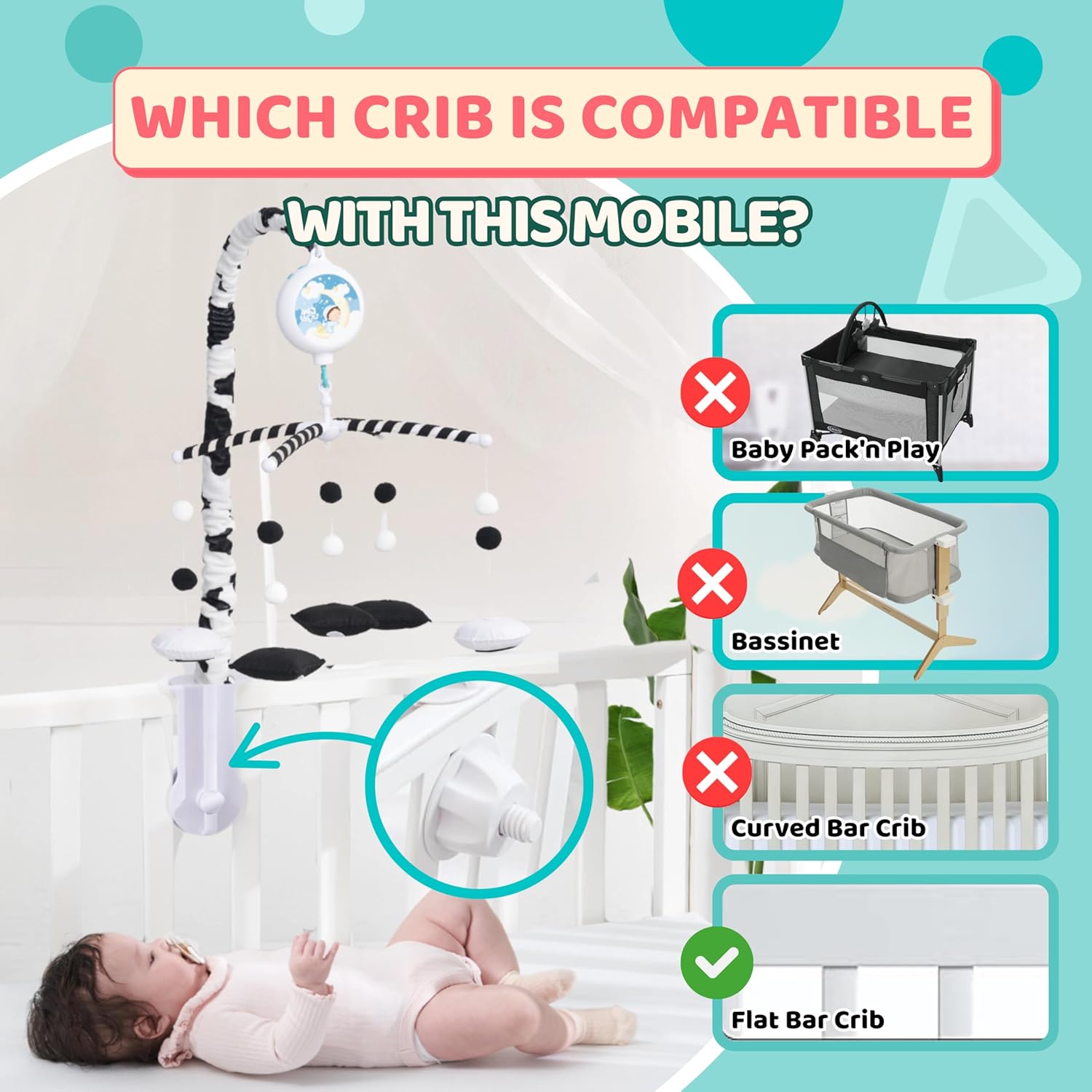
A mobile is only as good as its mount. The TINITIGIES mobile utilizes a clip-on installation mechanism requiring no screws or tools. The arm is constructed from non-toxic, durable ABS plastic. This material choice is significant: ABS is impact-resistant, heat-resistant, and free from BPA, phthalates, and lead, meeting standard toy safety regulations (ASTM F963 / CPSIA).
The clamp is rated for crib rail thicknesses up to 1.54 inches (approx. 39mm). This accommodates the vast majority of standard full-size crib rails. However, the manufacturer issues a prominent, bolded warning: “Designed for standard-size cribs only. This is not a bassinet mobile.” The FAQ elaborates that many returns stem from buyers attempting to mount this on bassinet rails, which are often thinner, curved, or vertically oriented differently. The arm length and clamp geometry are optimized for the vertical side rail of a stationary crib. Parents must measure their crib rail thickness and profile before purchasing. If the rail exceeds 1.54 inches or is a non-standard shape (e.g., thick sleigh bed style), the clamp will not secure safely.
The arm extends outward to position the mobile over the mattress surface. The “baby’s eye view” design implies the hanging elements drop to the optimal focal distance (approx. 12 inches from the baby’s face). Parents should verify the arm reach against their specific crib dimensions to ensure the mobile isn’t too far away (ineffective) or too close (safety hazard/grabbing risk).
Warranty and Customer Assurance
Durability is a common pain point for battery-operated nursery gear. Motors strip, speakers blow, and plastic clips snap. TINITIGIES addresses this with a 1-Year Warranty that goes beyond the standard “manufacturer’s defect” language. The policy states: “If the mechanism stops working under normal use within 1 year, we will replace it one-for-one at no charge.” Furthermore, they note: “We carefully inspect every music mechanism before shipping.” This suggests a quality control checkpoint at the factory level and a hassle-free replacement policy that reduces the risk of purchase for the consumer. It signals confidence in the digital motor assembly’s longevity compared to cheaper wind-up alternatives.
Critical Considerations & Limitations
Based strictly on the product specifications, there are factors a buyer must weigh:
- Battery Dependency: Unlike wind-up mobiles, this requires 2 AA batteries. The convenience of 30-minute run times and volume control comes with the recurring cost and environmental impact of battery replacement. Rechargeable NiMH AAs are a viable workaround.
- Motor Noise: Digital motors are generally quieter than wind-up springs, but they are not silent. In a perfectly quiet room, a faint whirring/gearing sound may be audible during rotation. The “Rotation Only” mode will highlight this.
- Fixed Visuals: The animals and patterns are fixed elements. Unlike DIY Montessori mobiles where cards can be swapped for increasing complexity, this unit offers a static set of 5 patterns. It covers the high-contrast spectrum well but lacks modularity.
- Bassinet Incompatibility: This cannot be stressed enough. If the primary sleep space for the first 3–4 months is a bedside bassinet, this product will not fit safely. It is a crib-specific solution.
- Age Limit: The 0–5 month guideline aligns with the “grabbing” milestone. Once the infant can push up on hands and knees (approx. 5 months) or reach the hanging elements, the mobile must be removed immediately to prevent entanglement or pulling the unit down. This is a universal safety standard for all crib mobiles.
The Verdict: A Purpose-Built Developmental Tool
The TINITIGIES Montessori Mobile for Crib distinguishes itself in a crowded market by refusing to compromise infant developmental needs for adult aesthetic preferences. It is a specialized instrument: high-contrast where others are pastel; baby-oriented where others are parent-oriented; digital where others are mechanical.
For parents setting up a stationary crib as the primary sleep environment from day one (or transitioning to crib by 1–2 months), this mobile offers a scientifically grounded visual curriculum backed by a versatile, user-friendly audio system. The tool-free clamp, low-volume default, 30-minute timer, and robust 1-year replacement warranty create a high-value, low-friction user experience.
It is not a universal fit (bassinets excluded), nor is it a “grows with baby” toy that converts into a nightlight or projector. It does one thing—visual and auditory stimulation for the newborn phase—and it appears engineered to do that one thing exceptionally well. If your nursery centers on a standard crib and your priority is supporting your baby’s developing vision with Montessori-aligned materials, the TINITIGIES Black and White Animal Mobile presents a compelling, purpose-built argument for a spot on the registry.