



Price: [price_with_discount]
(as of [price_update_date] – Details)

Bringing the Woodland to the Nursery: A Detailed Review of The Peanutshell Crib Mobile for Girls
Designing a nursery is an exercise in balancing practicality with magic. Parents search for pieces that soothe a restless newborn, stimulate developing senses, and tie the room’s aesthetic together without overwhelming the space. The Peanutshell Crib Mobile for Girls in Pink and White positions itself squarely at this intersection. Marketed as a “Dreamy Explorer” piece, this musical mobile promises to transform a standard crib into a fantasy jungle tableau, complete with a versatile digital sound system and a user-friendly mechanical design. Based on the manufacturer’s specifications and product architecture, here is an in-depth analysis of what this nursery centerpiece offers.
Aesthetic Design: The “Little Forest” Theme
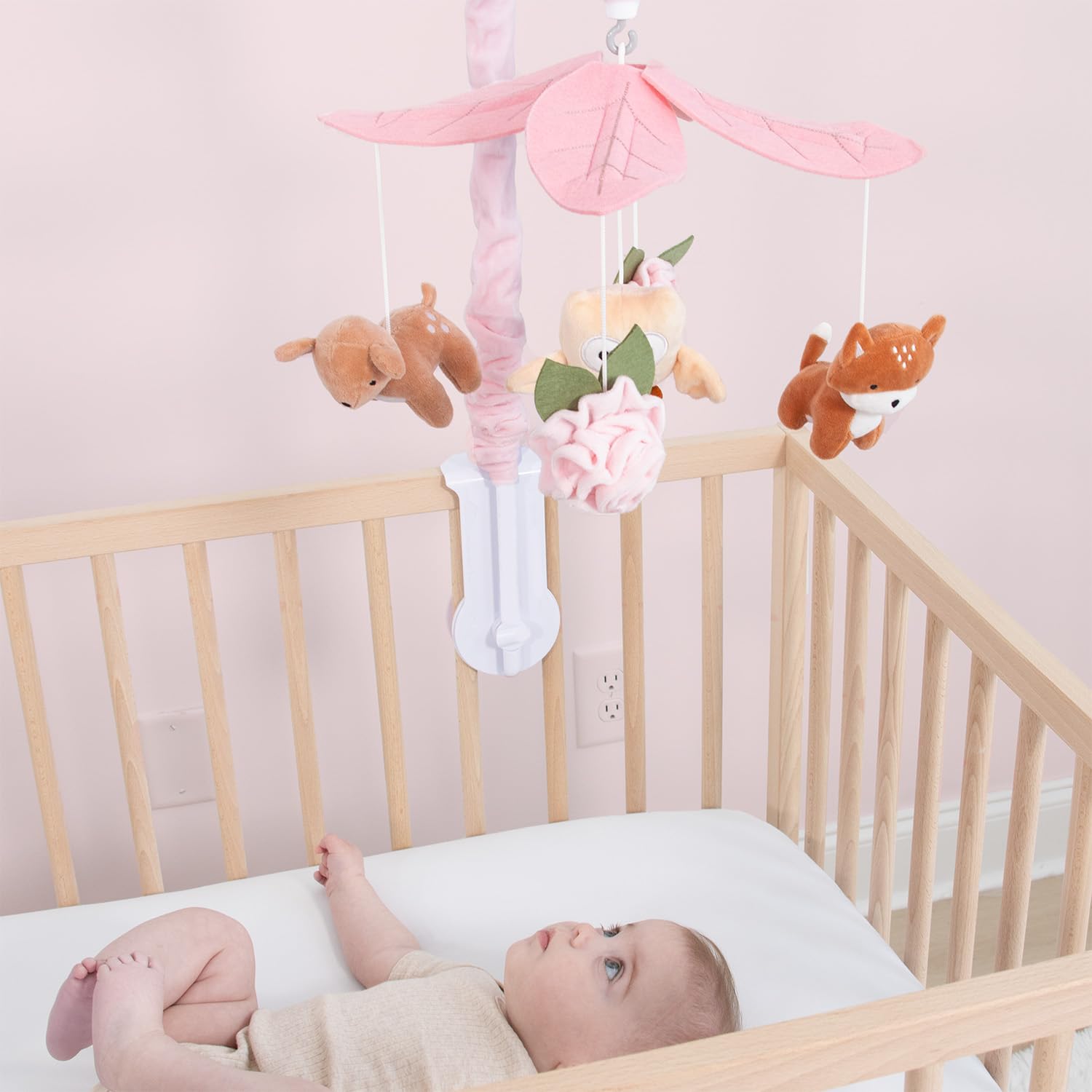
The visual identity of this mobile is built around a “Fantasy Jungle” concept, executed in a palette designed for a baby girl’s nursery but versatile enough for neutral spaces. The dominant tones are light pink and crisp white, softened by the organic shapes of fabric flowers and leaves. This isn’t a high-contrast, primary-color toy designed solely for visual tracking; rather, it leans into a muted, storybook aesthetic that mimics high-end nursery bedding collections.
The character cast consists of three distinct woodland creatures: an owl, a deer, and a fox. These are rendered as plush, three-dimensional hanging toys. The choice of animals is deliberate—owls suggest wisdom and night-time watching, deer imply gentleness, and foxes add a touch of playful curiosity. Suspended beneath a canopy that features floral and leaf motifs, the ensemble creates a vertical vignette. The product imagery suggests a “spinner” mechanism, meaning the horizontal arm rotates slowly, carrying the plush characters in a gentle orbit above the crib. This rotation is central to the “Dreamy Explorer” branding, turning the mobile into a kinetic sculpture that adds depth and movement to the room even when the music is off.
The materials appear to be soft textiles—likely polyester blends—chosen for tactile safety. For a newborn, the world is blurry; for a three-to-six-month-old, these dangling figures become the first “friends” they reach for. The vibrant colors mentioned in the description (likely accents on the animals or the floral elements) provide necessary visual contrast against the pastel base, aiding in visual development without clashing with the “Pink and White” decor scheme.
Audio Engineering: The Digital Music Box
Where many mobiles rely on a mechanical wind-up chime that plays a single, tinny loop until the spring unwinds, The Peanutshell unit integrates a digital music box. This is a significant functional upgrade. The headline feature is the library of 12 distinct lullabies. This variety addresses one of the most common pain points for parents: auditory fatigue. A mobile that plays only “Brahms’ Lullaby” on a 90-second loop becomes a source of stress for the caregiver within days. With twelve tracks, the rotation can span hours before a repeat, keeping the auditory environment fresh for both baby and parent.
The inclusion of volume control is non-negotiable for modern nursery gear, and its presence here is welcome. Newborns have sensitive hearing; the ability to dial the output down to a barely audible whisper—or up to a level that masks household noise during a nap—is critical. The description specifies a “digital music box,” implying clean, sampled audio reproduction rather than the metallic plucking of a traditional comb mechanism. This likely results in a warmer, more immersive soundscape that mimics a streaming playlist rather than a mechanical toy.
Operational Mechanics: The Three-Mode System
The motor unit is the heart of the mobile, and the manufacturer has designed it with a “Just One-Click” philosophy. The control scheme offers three distinct operational modes, selectable via a simple interface on the music box housing:
- Music Only: The arm remains stationary while the lullabies play. This is ideal for the very newborn stage where motion might be overstimulating, or for toddlers who have outgrown the visual tracking but still associate the music with sleep cues.
- Rotation Only: The arm spins silently. This serves as a pure visual soother—kinetic art for the crib. It allows the baby to practice visual tracking and focus on the moving plush toys without auditory input, useful during “quiet alert” phases.
- Music + Rotation: The full immersive experience. The woodland scene comes alive with both soundtrack and motion.
This modularity extends the product’s lifespan significantly. A single-function mobile becomes obsolete the moment a baby’s needs shift. A three-mode mobile adapts: visual stimulation at two months, audio-visual soothing at four months, and a sleep-signal music player at twelve months. The “one-click” switching implies a tactile button or switch that can be operated in a darkened room without fumbling—a small but vital UX detail for sleep-deprived parents.
Installation Architecture: Standard Fit & Detachable Convenience
The mounting hardware is designed for standard-size cribs, utilizing a classic clamp-on rail attachment. The product description emphasizes a “Quick Set-Up” time of minutes, suggesting a tool-free assembly process. Typically, this involves tightening a thumbscrew clamp onto the crib rail, inserting the vertical support post, and snapping the horizontal arm/music box unit into place.
A standout structural feature is the detachable arm. The description highlights that this makes the mobile “very easy to move or store.” This is a thoughtful engineering decision. Standard mobiles are often semi-permanent fixtures; removing them requires unscrewing the clamp or dismantling the arm. A quick-release mechanism on the horizontal arm allows a parent to lift the entire mobile canopy and toy assembly off the vertical post in seconds. This facilitates:
- Sheet Changes: No more maneuvering a fitted sheet around a fixed mobile arm.
- Room Transitions: Moving the mobile from the nursery crib to a travel crib or pack-n-play in another room.
- Storage: Compact storage when the baby transitions to a toddler bed.
- Conversion Potential: Many parents eventually remove the arm and music box, converting the plush toys into standalone tactile toys or stroller attachments (though the description doesn’t explicitly list clips for this, the detachability opens the door).
Developmental Utility: More Than Decor
The product description explicitly states: “More than just a musical nursery mobile, this piece doubles as the cutest nursery decor.” This duality is the core value proposition.
Visual Tracking & Focus: The slow, consistent rotation of the three distinct animals (Owl, Deer, Fox) against the floral canopy provides a perfect target for developing eyes. At birth, babies see high contrast best; the pink/white/color-pop palette serves this. By month three, they track smooth pursuit movements—the rotation trains this skill.
Auditory Discrimination: Twelve lullabies expose the infant to varied melodic structures, tempos, and timbres, laying groundwork for language processing and musical appreciation.
Object Permanence & Recognition: As the baby grows, the specific characters become recognizable “objects.” The owl is always the owl; the fox is always the fox. This consistency builds cognitive mapping.
Self-Soothing Association: The ultimate goal of any mobile is to become a sleep cue. The consistency of the “One-Click” start-up—the same whir of the motor, the same first notes of the selected lullaby—creates a Pavlovian trigger: Mobile On = Sleep Time.
Safety & Build Considerations
While the provided text does not list specific safety certifications (ASTM, JPMA, etc.), the design language implies adherence to standard crib mobile safety norms.
- Strangulation Hazard Mitigation: The arm mounts high on the rail, keeping the hanging toys well out of reach of a lying infant. The “detachable arm” feature actually enhances safety by ensuring the mobile is completely removed once the baby can push up on hands and knees (the standard 5-month/ push-up milestone for mobile removal).
- Plush Attachment: The animals hang via short tethers/loops. The description notes “plush rail soother spinner” in the image tags, suggesting the toys are securely stitched to the rotating mechanism.
- Battery Operation: The digital music box and motor require batteries (typically AA or AAA, not included usually). The housing is likely secured with a screw to prevent baby access.
The “Forest Baby” Decor Integration
Nursery design trends have shifted heavily toward “themed but tasteful.” The “Little Forest” theme—owls, foxes, deer, florals—is a perennial bestseller because it feels gender-adjacent (pink for girls, but the animals are neutral) and transitions well into toddler room decor. The Peanutshell mobile doesn’t look like a piece of plastic baby gear; it looks like a textile art installation. The “vibrant colors toys” mentioned in the description likely refer to the specific detailing on the fox (orange/rust), the deer (soft brown/tan), and the owl (cream/grey/pink accents), which pop against the pastel canopy. This allows the mobile to serve as the anchor piece for the room’s color story, pulling together bedding, wall art, and rug choices.
Potential Limitations to Consider
Based strictly on the provided specifications, a few considerations emerge for the discerning buyer:
- Battery Dependency: Unlike wind-up mobiles, this requires ongoing battery purchases. High-quality rechargeable batteries are recommended for the motor/music box combo to maintain consistent rotation speed and audio fidelity.
- Motor Noise: “Gentle rotation” implies a motor. While modern motors are quiet, they are not silent. In a perfectly quiet room, a faint gear whir may be audible. The “Rotation Only” mode tests this specifically.
- Character Set Fixed: The trio is Owl, Deer, Fox. There is no option to swap characters or add more. Three is a standard, balanced number for weight distribution on the arm.
- Age Limit: As with all mobiles, this must be removed when the baby begins to push up (approx. 5 months). The usable window as a crib mobile is roughly 0–5 months, though the music box detaches for continued use as a sound machine.
Verdict: A Curated Nursery Essential
The Peanutshell Crib Mobile for Girls in Pink and White succeeds in categorizing itself not as a toy, but as a nursery system component. It solves the “mobile problem” by offering high audio variety (12 songs), operational flexibility (3 modes), and installation intelligence (detachable arm/standard fit). It respects the parent’s need for volume control and easy sheet changes, while respecting the baby’s need for gentle, non-overstimulating sensory input.
The “Dreamy Explorer” woodland theme is executed with a level of textile sophistication that elevates it above the mass-market plastic competition. It photographs beautifully for the inevitable nursery reveal, functions reliably for the daily grind of nap routines, and packs away neatly when the crib days are over. For parents building a “Little Forest” sanctuary, this mobile acts as the kinetic heartbeat of the room—spinning stories of owls, deer, and foxes until the little one drifts off to sleep.