



Price: $5846
(as of Oct 14, 2026 00:09:46 UTC – Details)

Mobil 1 High Mileage Full Synthetic Motor Oil 5W-20 (5 Quart): A Technical Deep Dive into Extended Engine Preservation
As the automotive landscape shifts toward longer vehicle ownership cycles, the demands placed on engine lubricants have fundamentally changed. The modern driver is no longer simply looking for a fluid that meets baseline viscosity requirements; they require a sophisticated chemical package capable of mitigating the specific degradation pathways inherent to aging powertrains. The Mobil 1 High Mileage Full Synthetic Motor Oil 5W-20, packaged in the convenient 5-quart container, represents a targeted engineering response to this challenge. Leveraging the brand’s signature Triple Action Formula and the latest ILSAC GF-7 certification, this lubricant is positioned as a premium solution for vehicles exceeding 75,000 miles, promising a guaranteed 15,000-mile protection interval.
The Triple Action Formula: Deconstructing the Chemistry
At the core of this product’s architecture lies the proprietary Triple Action Formula. Marketing terminology aside, this framework describes three distinct, interdependent performance pillars: performance, protection, and cleanliness. In a high-mileage context, these pillars address the “death spiral” of engine aging: increased friction leads to heat, heat accelerates oxidation, oxidation creates deposits, and deposits further increase friction.
The “Performance” aspect is anchored in the 5W-20 viscosity grade. The “5W” winter rating signifies a low-temperature cranking viscosity that ensures near-instantaneous oil flow upon ignition—a critical factor given that the majority of engine wear occurs in the first few seconds of a cold start. The “20” operational viscosity provides the necessary hydrodynamic film strength at 100°C (212°F) to separate moving parts under load, while maintaining the low-viscosity profile mandated by modern OEMs for fuel efficiency and variable valve timing (VVT) system actuation.
The “Protection” pillar is where the high-mileage specification differentiates itself from standard Mobil 1 formulations. As engines accumulate mileage, seal elasticity diminishes, cylinder wall cross-hatching wears smooth, and clearances between bearings and journals widen. This formulation incorporates specialized seal conditioners designed to permeate elastomer materials (viton, silicone, rubber), causing a controlled swell that restores sealing capability. This directly addresses the minor seepage and oil consumption issues common in the 75,000+ mile demographic. Furthermore, the additive package is fortified with enhanced anti-wear agents—likely advanced zinc dialkyldithiophosphate (ZDDP) derivatives or molybdenum complexes—that provide a sacrificial boundary layer when the hydrodynamic film is compromised by excessive clearances.
The “Cleanliness” pillar targets the arch-nemesis of longevity: sludge and deposits. The product description explicitly cites “specialty components in synthetic oil extend engine life by reducing the friction that causes deposits and sludge buildup.” High-mileage engines are thermally less efficient; blow-by gases introduce fuel and soot into the crankcase, while higher operating temperatures accelerate the polymerization of oxidized oil into varnish and sludge. The detergent/dispersant package in this formulation is calibrated for high solvency, keeping insoluble contaminants suspended in the oil matrix rather than allowing them to plate out on piston rings, valve decks, and oil pickup screens. This ensures that critical oil passages remain unobstructed, maintaining oil pressure integrity.
The 15,000-Mile Guarantee: Oxidation Stability and Base Stock Integrity
The claim of guaranteed protection for up to 15,000 miles between oil changes is the most aggressive drain interval statement in the consumer market. This is not an arbitrary number; it is a direct function of the base stock quality and the antioxidant reserve capacity.
Mobil 1 utilizes a Full Synthetic base stock—specifically a blend of Group III (hydrocracked) and Group IV (Polyalphaolefin – PAO) base oils. Unlike conventional mineral oils, these synthetic hydrocarbons possess a uniform molecular structure with no paraffin waxes and minimal sulfur/nitrogen impurities. This molecular uniformity yields two critical advantages for extended drains:
- Inherent Oxidation Resistance: Saturated hydrocarbon chains lack the double bonds that serve as attack sites for oxygen radicals at high temperatures. This drastically slows the formation of acids and polymerization products (sludge/varnish).
- Volatility Control (Noack Volatility): Synthetic base oils exhibit significantly lower evaporation loss at high temperatures. This prevents the oil from thickening over the service interval (which would starve the top end of lubrication) and reduces oil consumption via the PCV system.
The description highlights superior oxidation control as a specific benefit of meeting ILSAC GF-7 standards. GF-7 represents the latest iteration of the International Lubricant Specification Advisory Committee standards, superseding GF-6. The transition to GF-7 introduced more stringent testing protocols, specifically the Sequence IIIH oxidation test and the Sequence IVB valvetrain wear test, both run at higher temperatures and longer durations than previous generations. Passing GF-7 certifies that the antioxidant package (likely a synergistic blend of hindered phenols, aromatic amines, and metal deactivators) possesses the reserve alkalinity (TBN retention) to neutralize acidic blow-by byproducts for the full 15,000-mile duration.
ILSAC GF-7: Addressing Modern Failure Modes (LSPI and Timing Chains)
The adoption of the ILSAC GF-7 standard is a pivotal technical credential for the 5W-20 viscosity grade. Modern engines—specifically Turbocharged Gasoline Direct Injection (TGDI) units prevalent in the current high-mileage fleet—suffer from two specific failure modes that GF-7 explicitly targets: Low-Speed Pre-Ignition (LSPI) and Timing Chain Wear.
LSPI Protection: LSPI is an abnormal combustion event occurring at low speeds/high loads where the air-fuel mixture ignites prematurely, generating cylinder pressures capable of fracturing pistons and bending connecting rods. Research has conclusively linked LSPI frequency to oil formulation—specifically, calcium-based detergents promote LSPI, while magnesium-based detergents and molybdenum anti-wear additives suppress it. The GF-7 certification mandates passing the GM ODPP (LSPI) test, confirming that Mobil 1 High Mileage 5W-20 utilizes a detergent/anti-wear chemistry balanced to minimize LSPI risk. For a high-mileage vehicle where carbon deposits in the combustion chamber act as hot spots (glow plugs), this suppression capability is a significant durability safeguard.
Timing Chain Wear: Direct injection engines often utilize long, single-row timing chains tensioned by hydraulic actuators fed by engine oil pressure. These chains are susceptible to “chain stretch” (pin/bushing wear) caused by soot contamination and inadequate anti-wear films. The GF-7 Sequence IVB test evaluates timing chain wear rigorously. The “enhanced protection against timing chain wear” cited in the description confirms the formulation maintains film strength at the chain tensioner and guide interfaces, preserving valve timing accuracy—critical for emissions compliance and fuel economy in older, sensor-sensitive engines.
Cold-Start Dynamics and Low-Temperature Pumpability
The 5W rating is not merely a suggestion; it is a defined limit on Cranking Viscosity (CCS) at -30°C (-22°F) and Pumping Viscosity (MRV) at -35°C (-31°F). The description emphasizes “excellent cold-start and low-temperature performance.” In a high-mileage engine, battery cranking amperage is often reduced, and starter motor draw is higher due to worn bearings. An oil that exceeds the 5W CCS limit (6,600 cP max) places undue strain on the starting system.
Furthermore, the MRV (Mini-Rotary Viscometer) test measures yield stress—the stress required to initiate oil movement. If the oil gels (structurally solidifies due to wax crystallization or polymer network formation) at low temperatures, the pickup tube draws a vacuum, cavitating the pump and starving the engine of lubrication during the most critical wear phase. The synthetic base stock’s lack of paraffin wax, combined with pour point depressants (PPDs) and viscosity index improvers (VIIs) engineered for shear stability, ensures the oil remains a Newtonian fluid (flowing immediately under gravity and pump suction) even in sub-arctic conditions.
The 5-Quart Format: Practical Engineering for the DIY Maintainer
The packaging in a 5-quart jug is a deliberate ergonomic and logistical choice. The vast majority of modern 4-cylinder and V6 engines—which constitute the bulk of the 75,000+ mile vehicle parc—require between 4.5 and 5.5 quarts of oil with a filter change. This single-container format eliminates the waste and cost of purchasing individual quart bottles (reducing plastic waste by ~80%) and ensures the user has the precise volume required for a complete fill without needing a second, partially used container. The jug design typically incorporates a precision pour spout and ergonomic handle, minimizing spillage—a safety and environmental consideration.
Market Position: The NASCAR® and Retail Leadership Connection
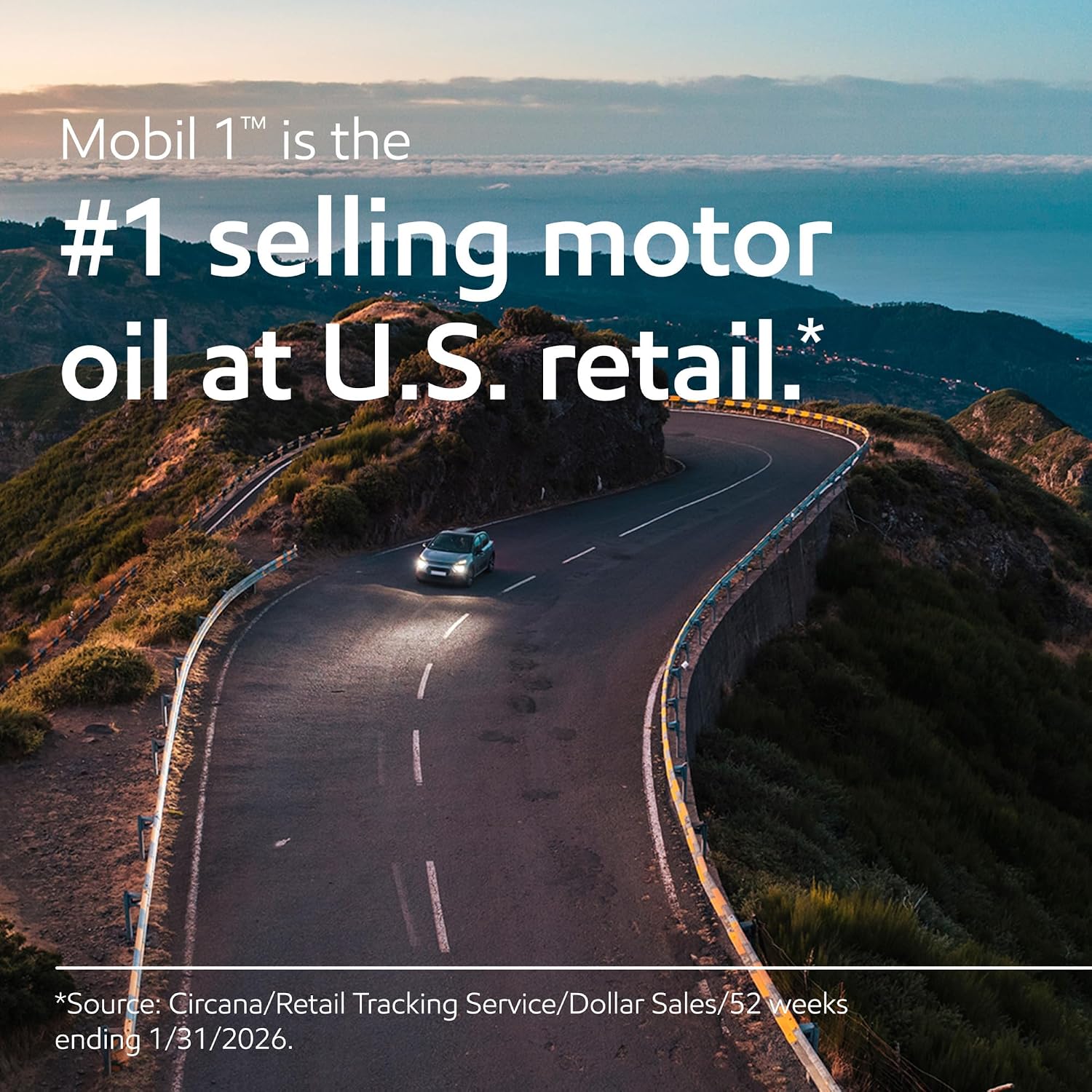
The description cites two significant trust signals: #1 selling motor oil in America at retail and Official Motor Oil of NASCAR®.
While motorsport lubricants bear little chemical resemblance to street-legal API/ILSAC oils (racing oils run high ZDDP, no detergents, and zero emissions compliance), the NASCAR partnership serves as a rigorous stress-testing platform. Mobil 1 uses the NASCAR Cup Series as a rolling laboratory for base stock durability and additive response under extreme thermal and shear loads (sustained 9,000+ RPM, 300°F+ oil temps). The data telemetry gathered—bearing wear rates, oxidation kinetics, viscosity shear loss—feeds directly into the R&D pipeline for consumer formulations like the High Mileage series. The “Trusted and recommended by car builders and experienced mechanics” claim reflects the installer preference for a product with zero defect rates, consistent viscosity batch-to-batch, and broad OEM approval coverage (likely including dexos1 Gen 3, Ford WSS-M2C962-A1, Chrysler MS-6395), reducing liability for professional shops.
Application Scope: The 75,000-Mile Threshold
The designation “High Mileage for engines 75,000+ miles” is a chemical demarcation line. Below this threshold, standard Mobil 1 Extended Performance or Annual Protection is typically sufficient. Above it, the seal conditioner package becomes necessary, the higher detergent load is required to manage existing deposit loads (preventing “detergent shock” where a high-detergent oil dislodges large chunks of sludge in a neglected engine—though Mobil 1’s solvency is designed for controlled cleaning), and the anti-wear chemistry is tuned for wider clearances.
It is critical to note the 5W-20 viscosity specification. This oil is not a universal high-mileage fluid. It is strictly for applications where the OEM specifies 5W-20 (or 0W-20). Using it in an engine spec’d for 5W-30, 10W-30, or 5W-40 (common in older V8s, heavy-duty trucks, or European makes) would result in insufficient High-Temperature High-Shear (HTHS) viscosity, leading to bearing wear and low oil pressure at operating temperature. The user must verify the vehicle manufacturer’s viscosity recommendation—typically found on the oil fill cap or in the owner’s manual—before selection.
Summary: A Systems Approach to Aging Powertrain Management
The Mobil 1 High Mileage Full Synthetic Motor Oil 5W-20 (5 Quart) is not merely a commodity lubricant; it is a engineered fluid system designed to arrest the specific degradation mechanisms of the 75,000-mile+ powertrain. By combining a PAO/Group III synthetic base stock for oxidation and volatility resistance, a GF-7 certified additive package for LSPI and timing chain protection, a seal conditioner package for elastomer rejuvenation, and a high-solvency detergent system for sludge management, it offers a technically coherent solution for extending the operational lifespan of the modern engine.
The 15,000-mile guarantee serves as a warranty-backed testament to the oxidative stability reserve of the formulation, provided the engine is in sound mechanical condition (no fuel dilution, coolant leaks, or excessive blow-by). For the DIY enthusiast or professional technician servicing the modern high-mileage fleet, the 5-quart packaging delivers the correct volume, the correct chemistry, and the correct certification in a single, efficient unit. It represents the current apex of API/ILSAC-compliant lubrication technology tailored specifically for the aging engine.